The Problem No One Talks About
Everyone is building AI agents. Few are asking the right question first: Are my systems actually ready to be called by one?
Many organizations build agents on top of systems that fundamentally don’t support them. The vulnerabilities were always there. Agents just amplify them at machine speed, and what was a manageable limitation becomes a hard blocker at scale.
This is the problem Agentic Readiness solves.
What Is Agentic Readiness?
Agentic Readiness is preparing your existing systems to support AI agents that can reliably operate on their own. It’s not about building better agents — it’s about building better foundations for agents to work on.
Think of it this way: if your APIs can’t be cleanly discovered and invoked, if your authentication can’t distinguish between a human and an agent, if your system can’t handle retries at machine speed — your agent will fail. Not because the agent is bad, but because the environment is hostile.
AWS Modernization vs Agentic Assessment
These are two distinct evaluations. Modernization assessment (MODA) evaluates whether an application is architecturally mature enough to run efficiently in the cloud. Agentic Readiness (ARA) evaluates whether an agent can interact with that application safely and effectively. You need both — a cloud-native system is not automatically agent-ready, and an agent-ready system is not automatically well-architected (*).
What is Agentic Readiness Analysis (ARA) Tool?
AWS recently launched two tools under AWS Transform Custom specifically for this problem:
- ARA (Agentic Readiness Analysis) — Are your systems ready to be called by AI agents?
- MODA (Modernization Analysis) — What are the cloud-native maturity gaps?
Both are code analysis tools. You connect your repository and run them against your codebase. They complement each other — ARA tells you what’s not agent-ready, MODA tells you why and what to fix at the cloud-native level.
Inmy next article, I’ll walk through a step-by-step guide on how to run ARA against a real codebase and interpret the results.
What Agentic Readiness Analysis (ARA) Actually Evaluates?
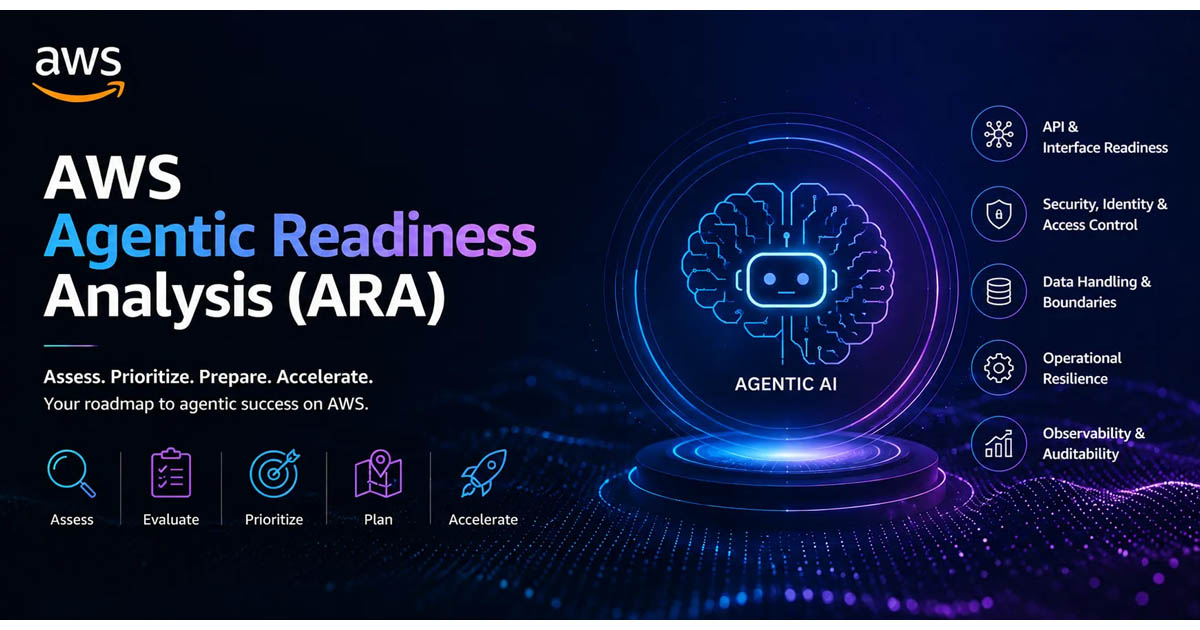
ARA runs 45 questions across 5 pillars:
1. API & Interface Readiness
Can agents discover, invoke, and interpret responses cleanly? Are your APIs documented, consistent, and machine-parseable?
2. Security & Identity
Can the system authenticate agents as distinct identities? Can it scope their access appropriately? If an agent goes rogue, can you contain the blast radius?
3. Operational Resilience
Can the system handle retries, concurrency, and failures at machine speed? Agents invoke tools programmatically and repeatedly — without the natural pacing of a human operator. Your system needs to handle that.
4. Data Handling
Is data scoped, classified, and structured for agent consumption? Agents need to know what data they can access, where it lives, and how to interpret it.
5. Observability
Can you reconstruct what an agent did? When it breaks — and it will — can you debug the full chain of actions?
AWS Agentic Readiness Analysis Spectrum
After analysis, each finding is classified by severity:
- High (Blocker): The application cannot be safely used by agents until this is resolved.
- Medium (Risk): Agents can interact with the application, but operational risk is elevated.
- Low (Advisory): Gaps that reduce efficiency or observability but do not prevent safe interaction.
Severity is contextual — the same gap may receive a different classification depending on whether agents are reading data (resource use) versus modifying state (tool use). A read-only gap is lower risk than the same gap on a write operation.
AWS ARA Outputs — What You Actually Get
ARA produces three types of output:
- Executive Summary : High-level readiness classification with business context
- Detailed Findings: Per-pillar breakdown with specific remediation steps
- Portfolio Roll-up Data: Structured output that feeds into organization-wide readiness views
The detailed findings don’t just identify problems — they tell you exactly what to remediate and why.
What AWS ARA Is Not?
Let’s be clear about boundaries:
- ARA evaluates the code and system — not the agent
- It assesses how prepared the environment is for agents — not how to build agents
- It does not replace the AWS Well-Architected Framework
- It’s about readiness for agentic integration — a specific, scoped evaluation
The Bottom Line
Stop building agents and hoping the systems will keep up. Assess first. Remediate the gaps. Then build with confidence.
ARA gives you the data to make that decision — per system, per use case, at portfolio scale.
Resources
Noor Sabahi | GenAI Practice Manager, New Math Data | June 2026
#AgenticAI #AWSTransform #GenerativeAI #CloudModernization #AmazonBedrock #AIAgents #AgenticReadinessAnalysis #ARA #AWS