
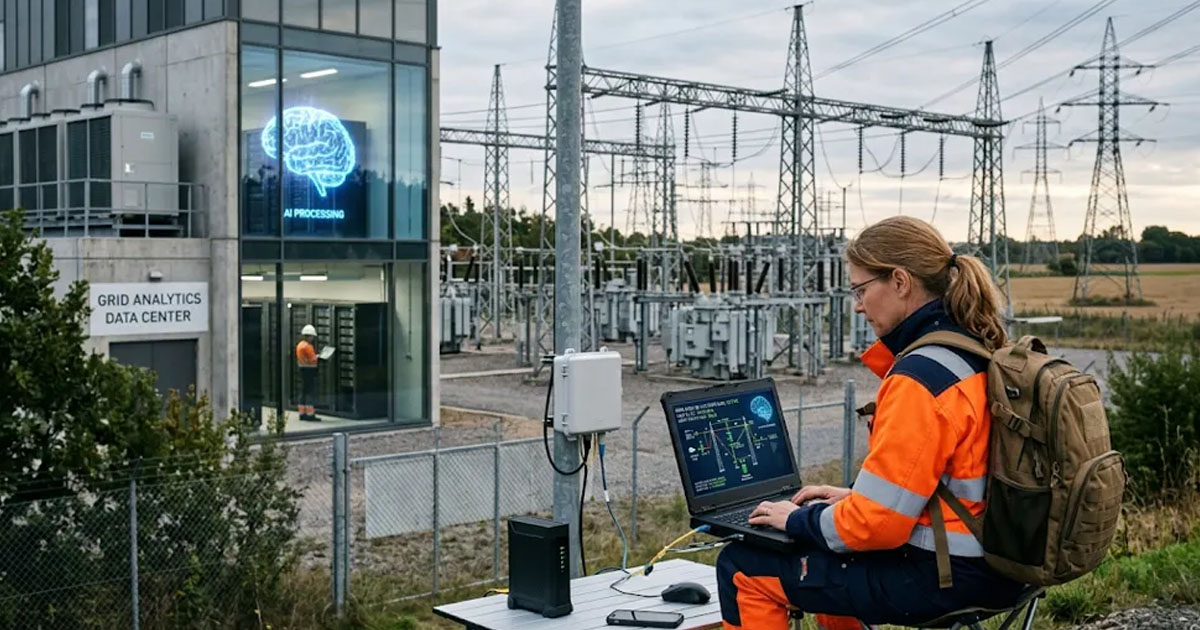
Foundation models for power systems are an emerging transformative technology focused on how we approach grid analytics. Instead of relying on traditional task‑specific tools, these models draw on large‑scale Artificial Intelligence (AI) systems trained on extensive power system data, allowing them to support a wide range of operational and planning tasks with far greater speed and flexibility. Among the topics covered by this technology and the advantages it proposes are topology generalization, accelerated computation, and reusable infrastructure. This is supported by cloud computing infrastructure and large datasets used for training AI models. But how did we get here?
Looking at the evolution of AI, there is a clear progression toward what we now call foundation models. Early symbolic expert systems from the 1960s were hand‑crafted and brittle, and by the 1990s we shifted into big data and general‑purpose machine learning, powerful, but still heavily dependent on task‑specific, hand‑engineered features.
Then came the deep learning wave around 2012, enabled by major jumps in compute performance. It changed the landscape, but most models were still trained in a supervised way on large annotated datasets, which made them highly specialized for individual tasks.
Foundation models take a different path. Instead of relying on labeled datasets, they learn through self‑supervision on massive, content‑rich collections of data. Because they’re trained at scale and not tied to a single annotated dataset, they’re able to generalize across many applications. This ability to learn from huge amounts of unlabeled data, which is far easier to obtain, is what gives foundation models their real power and flexibility.

With this momentum behind foundation models, developers are exploring how they might support a wide range of activities across the power‑system analysis space, everything from transient and dynamic stability studies to cybersecurity applications. There’s a lot of excitement around what this technology could unlock, and in my view, sometimes the expectations (and the stakes) can get pretty high.
Foundation models occupy a very different value position depending on whether the underlying power‑system activity is deterministic or probabilistic. Many operational and protection‑oriented tasks, such as dynamic simulation, stability assessment, fault analysis, and steady‑state or optimal power‑flow calculations, belong to a class of deterministic, physics‑driven processes. These activities rely on well‑defined equations, numerical solvers, and repeatable outcomes; their accuracy is guaranteed by physical laws rather than historical patterns. In these domains, replacing established deterministic engines with a foundation model that merely imitates their outputs offers no real gain: the industry already has fast, validated, explainable tools, and introducing a learned approximation only adds opacity and potential error.
In contrast, planning, forecasting, market behavior, risk assessment, and cyber‑physical security form a broad group of probabilistic, uncertainty‑dominated activities. Examples include demand and renewable forecasting, price formation, cascading‑failure risk, expansion planning, intrusion detection, and vulnerability assessment. These tasks depend on stochastic inputs, evolving conditions, and large scenario spaces where traditional models struggle to capture nonlinear interactions or adapt to new patterns. Here, foundation models feel like a natural evolution: they can integrate heterogeneous data, learn from variability, quantify uncertainty, and generate robust predictions or decision support. In these probabilistic domains, the structure and flexibility of foundation models directly enhance the industry’s ability to optimize under uncertainty, making them a meaningful advancement rather than a redundant mimic of established deterministic solvers.

It’s important to clarify that many of these capabilities haven’t been tested in real operational environments yet. Most deployments are still experimental. In areas like forecasting, foundation models are already gaining traction and showing real value, largely because they represent a natural evolution of techniques the industry has been refining for years. But in other domains- system security, load flow, planning- there’s still plenty to unpack. The effectiveness, reliability, and overall value of foundation models in these applications remain open questions, and the industry is just beginning to explore what’s truly feasible.
The Rise of GridFM Initiatives
Right now, there are two big players in this landscape: Microsoft’s GridFM initiative and LF Energy’s GridFM (OpenGridFM). Together, they reflect a shift toward AI‑native grid analysis: models trained on massive power system data that can generalize across topologies, accelerate core computations, and serve as reusable backbones for downstream applications.
Microsoft’s GridFM and GridSFM initiatives differ fundamentally from LF Energy’s OpenGridFM in governance, scope, and maturity. OpenGridFM is fully open‑source and community‑governed under the Linux Foundation, emphasizing transparency, shared infrastructure, and broad industry participation. In contrast, Microsoft’s GridFM/GridSFM combines proprietary research with selectively open‑sourced components, operating under a vendor‑driven governance model that prioritizes productization, controlled releases, and integration with Microsoft’s cloud ecosystem.
Their primary focus also diverges. Microsoft centers on high‑fidelity, physics‑grounded AC optimal power flow (AC‑OPF) prediction and solver acceleration, aiming to create small, efficient neural surrogates for core deterministic computations. OpenGridFM adopts a wider analytical mandate, targeting a general‑purpose foundation model ecosystem for power‑system planning, operations, forecasting, and risk analysis.
In terms of model scale, Microsoft emphasizes compact, efficient models (tens to hundreds of millions of parameters) optimized for speed and deployment. OpenGridFM anticipates larger, multi‑modal architectures capable of ingesting diverse data streams from utilities, markets, and grid telemetry.
Their data pipelines reflect this difference: Microsoft provides a complete, reproducible pipeline for generating OPF‑solvable U.S. transmission models and large scenario corpora. OpenGridFM is building community‑driven pipelines intended to support global datasets, heterogeneous topologies, and collaborative contributions from utilities and vendors.
Finally, maturity is where the gap is most visible. Microsoft’s GridSFM is already released, benchmarked, and available through open repositories, with demonstrated performance improvements in OPF warm‑starting and generalization. OpenGridFM remains earlier in its development cycle, focused on ecosystem building, standardization, and assembling the shared infrastructure needed for large‑scale training.

However, the production of these models relies on large infrastructure. Capturing large datasets for training and running the models demands important infrastructure, making these models a “cloud-only” implementation. Some of the activities we are seeing covered by these initiatives are currently covered by simpler implementations that are portable and available to everyone. For instance, power‑flow analysis is a well‑established discipline, producing deterministic, reliable, efficient, and highly accurate results. Modern solvers are portable across platforms, require no prior training, and deliver outputs whose quality depends solely on the input data and the fidelity of the circuit model. Because of this maturity, shifting such a tool into a foundation‑model framework would likely introduce unnecessary complexity while yielding results that may not fully match their deterministic counterparts, ultimately reducing confidence in the outputs.
Finding value in application space for foundation models
AI excels at accelerating repetitive analytical tasks and transforming raw data into actionable information, while cloud computing provides effectively limitless, on‑demand computational capacity for enterprise‑scale workloads. Within this context, physics‑aware AI systems increasingly rely on established power‑system simulation tools and numerical methods to ground their predictions and enhance decision‑making. Yet foundation models introduce a different dynamic: they require vast datasets and substantial compute to learn behaviors that traditional, lightweight tools have delivered reliably for decades. This raises an important question: perhaps the true value of foundation models is not replicating existing tools, but unlocking new analytical capabilities that were previously impractical or impossible.
Utilities have spent decades investing in digital‑twin development, infrastructure discovery, grid modeling, and data reconciliation to coordinate legacy assets with modern technologies and rising demand. These activities form the backbone of reliable, safe, and affordable power‑system operation. Foundation models introduce a new opportunity in this space: they can act as reference models that help planners reconcile heterogeneous datasets, understand both the current and future state of the grid, and enhance analytical workflows with AI‑driven insights.
The current application spectrum offers a vantage point for testing and refining concepts around the value foundation models can bring to planning and operational activities in electric power utilities. As discussed, these early explorations will help identify which use cases the industry can genuinely benefit from as it moves toward adopting this technology. They will also support the development of physics‑aware foundation models that blend deterministic and probabilistic inputs, reduce redundancy across analytical workflows, and surface real value rather than simply shifting tasks from one domain to another.
With this conversation, we aim to spark a broader industry dialog about where foundation models can sincerely deliver value. Right now, foundation model developers in the electric power domain center on speed, faster analysis, faster computation, but often at a massive infrastructure cost. In many cases, that feels a bit like hitting the same nail with a bigger, more sophisticated hammer. The tool is fancier, but the outcome isn’t necessarily better. The real challenge isn’t just building the foundation model itself; it’s figuring out where it should be applied, which activities benefit from this technology, and where it can produce outcomes that truly move the needle for power‑system analytics.
At New Math Data, we continuously validate models and help our customers pinpoint where foundation models truly deliver value, integrating physics‑aware workflows that preserve confidence when uncertainty becomes a major challenge. Utilities around the world are already weaving AI into their processes, but as discussed in the blog, the real hurdle isn’t adopting or developing these technologies. The real work lies in identifying the activities where tools like foundation models genuinely enhance operations. That’s where utilities, consultants, and developers need to focus: ensuring smoother technology adoption by reducing redundancy and concentrating effort where AI can make a meaningful impact.