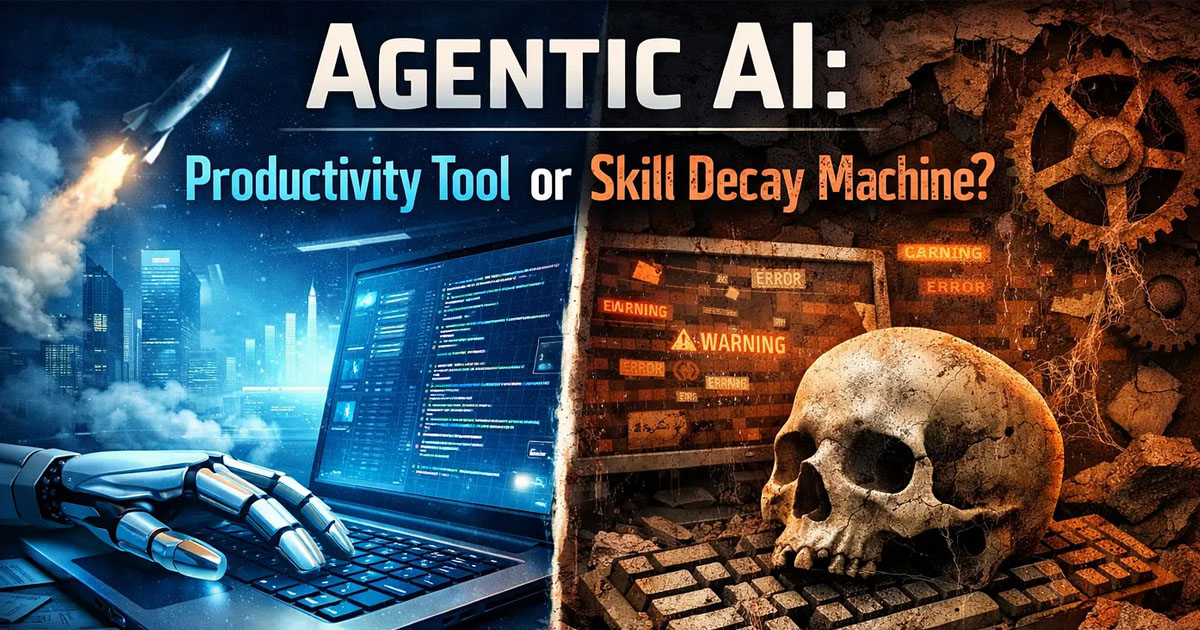
With the rapid advancement of generative AI and agentic development tools, a serious question is emerging:
What happens to a generation of engineers who rely entirely on Agentic AI without truly learning the fundamentals?
Across engineering teams, learning is increasingly outsourced to AI tools. Many developers are becoming less concerned with understanding core principles, trade-offs, architecture decisions, or even the pros and cons of the technologies they use. The assumption is simple:
“AI will figure it out.”
But what happens when engineers stop figuring things out themselves?
AI in the Loop vs Human in the Loop
Automation is not the enemy. In fact, it is one of the greatest accelerators of progress. In many domains, automation has solved complex problems and dramatically improved efficiency.
We already recognize the importance of Human-in-the-Loop (HITL) systems in sensitive areas, where human feedback, supervision, or approval is required. We know that some decisions must remain under human control.
But when it comes to AI-powered IDEs and agentic coding tools, the balance is quietly shifting.
Developers are increasingly becoming dependent — sometimes entirely dependent — on these tools. For some, it becomes difficult to function without them.
I use these tools myself. They are powerful. They increase productivity. They accelerate delivery.
But without discipline and boundaries, they introduce a serious risk.
The developer must guide the AI — not the opposite.
Dependency Without Understanding
Any engineer must have at least foundational knowledge of the domain they are working in before relying on an AI IDE to generate solutions.
If they do not have that knowledge, they must learn it — even if AI assists in the learning process.
Why?
Because without understanding:
- You cannot properly guide the AI.
- You cannot evaluate the correctness of its output.
- You cannot recognize hallucinations.
- You cannot detect bad practices or anti-patterns.
- You cannot judge architectural decisions.
When developers lack understanding, AI stops being a productivity tool and becomes a time sink.
Instead of saving time, engineers get trapped in loops:
- Prompting
- Regenerating
- Debugging hallucinated logic
- Fighting subtle architectural mistakes
Valuable hours are wasted — hours that could have been saved by reading the documentation and understanding the fundamentals.
Responsibility Is Not Transferable!
The developer must read every line of generated code.
The developer must validate, verify, and correct.
The developer is 100% responsible for the code at all times.
“The AI generated it” is not an acceptable excuse.
If you choose to use Agentic AI, you also choose full ownership of everything it produces.
There is no outsourcing of accountability.
The Dark Side of Agentic Coding
Agentic AI brings extraordinary advantages. But it also has risks, especially in software development:
- Overcomplicated implementations
- Hallucinated APIs or behaviors
- Subtle security flaws
- Hidden performance issues
- Anti-patterns embedded into production code
- Reinforcement of bad practices
If engineers stop learning, these risks multiply.
Knowledge is not optional.
When developers invest effort into understanding their field, they learn:
- Best practices
- Trade-offs
- Architectural reasoning
- Use cases and anti-patterns
- System thinking
AI cannot replace this depth. It can only amplify what already exists.
If the engineer is strong, AI amplifies strength.
If the engineer is weak, AI amplifies weakness.
A Healthier Model
Agentic tools are saving time.
Engineers need to invest time in:
- Learning
- Skill development
- Architectural thinking
- Deep system understanding
- Leadership growth
Engineers should not become faster typists of AI prompts.
They should become stronger thinkers.
The responsibility to grow belongs first to the engineer. No tool replaces personal discipline and continuous learning. Organizations can reinforce this through workshops, hackathons, design discussions, collaboration sessions, skill standards, and certifications — but they cannot substitute individual ownership.
Conclusion
Generative and Agentic AI are extraordinary innovations.
But if used without discipline, they become dangerous — not because of the technology itself, but because engineers may stop learning.
When developers stop gaining knowledge and fully outsource thinking to AI tools, they weaken their craft.
Agentic AI should be a productivity multiplier.
It should never become a substitute for understanding.
The future of engineering depends not on how powerful AI becomes — but on whether engineers choose to remain in control.
Author
Noor Sabahi | Senior AI & Cloud Engineer | AWS Ambassador
#TechnicalResponsibility #AIEthics #AIInTheLoop #Terraform #AgenticAI #DeveloperProductivity #HITL #GenAI #EngineerFuture