
A paradigm shift for advancing the electric power industry
Modern power system engineering increasingly depends on advanced digital simulation to support a wide spectrum of activities, including real-time grid operation, long-term planning, and comprehensive reliability assessment. These simulation environments empower engineers to anticipate abnormal operating conditions, evaluate evolving system requirements, and generate data-driven insights that inform both short-term operational strategies and long-term infrastructure investments. By bridging theory with practice, simulation has become a cornerstone of decision-making in the energy sector.
The growing demand for fast, reliable, and scalable simulation platforms has catalyzed continuous technological innovation over the past several decades. Central to this evolution is the ability to construct large-scale, high-fidelity models of transmission and distribution networks, capturing the complexity, heterogeneity, and integration of emerging technologies that characterize the modern electric grid. Such models must account for diverse elements, including distributed energy resources (DERs), advanced control schemes, and cyber-physical interactions, while remaining computationally efficient enough to support practical applications.
Power system analysis plays a vital role in the design and development of electrical networks. Through detailed calculations and simulations, engineers ensure that system components are properly specified to operate as intended, withstand expected stresses, and protect against potential failures. Simulation provides significant advantages, including greater efficiency, improved reliability, reduced costs, and stronger support for informed decision-making. By modeling system behavior, it becomes possible to detect vulnerabilities and emerging issues early, enabling proactive strategies that strengthen reliability and minimize the risk of outages.

A critical factor in developing reliable simulation models is the quality of the underlying data. Electric power system models rely on accurate physical representations of existing assets and their responses to a wide range of operating conditions and potential field events. Achieving this level of fidelity requires utilities to invest in collecting real‑time data and validating the condition and configuration of their infrastructure.
When this effort is carried out effectively, simulation models can closely reflect real‑world system behavior. Conversely, when simulations fail to accurately represent the grid’s present or future state, the root cause is often poor data quality.
Both proprietary software solutions and open-source alternatives have played pivotal roles in advancing simulation capabilities. Proprietary platforms often provide robust, industry-standard features with extensive validation and vendor support, making them indispensable for utility-scale applications. In parallel, open-source tools have gained significant traction across industry and academia due to their flexibility, transparency, and collaborative development models. These platforms foster innovation by enabling customization, peer review, and integration with emerging research, positioning them as key enablers of future advancements in power system simulation.
The facts…
The global market for power system simulators was valued at USD 1.36 billion in 2023 and is expected to expand at a compound annual growth rate (CAGR) of 6.9% from 2024 to 2030, according to Grand View Research. This growth is fueled by rising investments in modernizing aging power infrastructure and the increasing need for a dependable electricity supply. Power system simulation involves the use of specialized software to model, study, and replicate the performance of electrical networks, covering all stages from generation and transmission to distribution and end-use consumption.
In 2023, North America led the global power system simulator market, accounting for more than 34% of the total revenue. This dominance is largely driven by substantial investments in smart grid development across the region. Efforts are focused on advancing technologies that integrate sophisticated sensors, communication networks, and automation systems. Power system simulators play a pivotal role in this process, enabling the design and rigorous testing of smart grid components prior to large-scale deployment.
Emerging markets such as Asia Pacific and Europe are projected to expand over the coming years at an average CAGR of 7%. This growth is fueled by increased research and development (R&D) initiatives and rising economic activity, prompting these regions to make substantial investments in developing and adopting advanced tools that support long-term energy independence.
The challenges ahead
To strengthen their simulation models, utilities continuously collect and update system data, including Advanced Metering Infrastructure (AMI) inputs, ensuring that simulations remain accurate and representative of real-world conditions. Handling and storing this vast volume of information demands resilient communication networks and robust digital infrastructure, such as modern data centers. Equally important, the data must be easily accessible to diverse teams, enabling them to forecast system performance and make informed technical decisions for both planning and operational activities.
Cloud computing has become a versatile and powerful solution for infrastructure investment and data management, enabling utilities to accelerate their automation initiatives. By providing a broad range of service models, Software as a Service (SaaS), Platform as a Service (PaaS), and Infrastructure as a Service (IaaS), cloud providers facilitate the deployment of both cloud-native and hybrid environments. This digital foundation is further reinforced by integrated software and management tools that streamline data handling and ensure the delivery of essential services.
Modern cloud platforms increasingly incorporate advanced technologies such as Artificial Intelligence (AI) and Machine Learning (ML), allowing seamless integration of specialized capabilities for reasoning, analytics, and data manipulation. Supported by a flexible “pay-as-you-go” model, cloud computing offers utilities a cost-effective and scalable pathway to transition toward cloud-based architectures. Additionally, many providers, such as AWS and Azure, offer free-tier access, allowing professionals to experiment with and deepen their knowledge of cloud technologies. Together, these offerings empower both individual practitioners and utility organizations to fully leverage the transformative potential of cloud computing.
Cloud computing and ML are reshaping automation strategies across the electric power industry. Cloud computing delivers a wide range of services, servers, storage, databases, networking, software, and analytics over the internet, eliminating the need for organizations to invest in and maintain costly physical infrastructure. Instead, utilities gain on-demand access to scalable resources tailored to their operational needs.
Two defining features make cloud computing particularly compelling: Limitless Hardware Capacity (LHC) and Flexible Pricing Models (FPM). With LHC, providers offer elastic scalability, allowing resources to be expanded or reduced instantly in response to demand. This capability is especially valuable for workloads with fluctuating or unpredictable usage patterns, such as AI model training, complex simulations, or large-scale data processing.
Looking forward
Cloud platforms offer scalable, secure, and collaborative environments that support data‑intensive simulations while providing virtually unlimited storage capacity. In parallel, advanced AI models generate actionable insights by analyzing vast sensor networks and historical datasets. Together, these innovations signify more than just technological advancement; they mark a transformative shift in how utilities, researchers, and industry leaders approach resilience, efficiency, and sustainability across the energy sector.
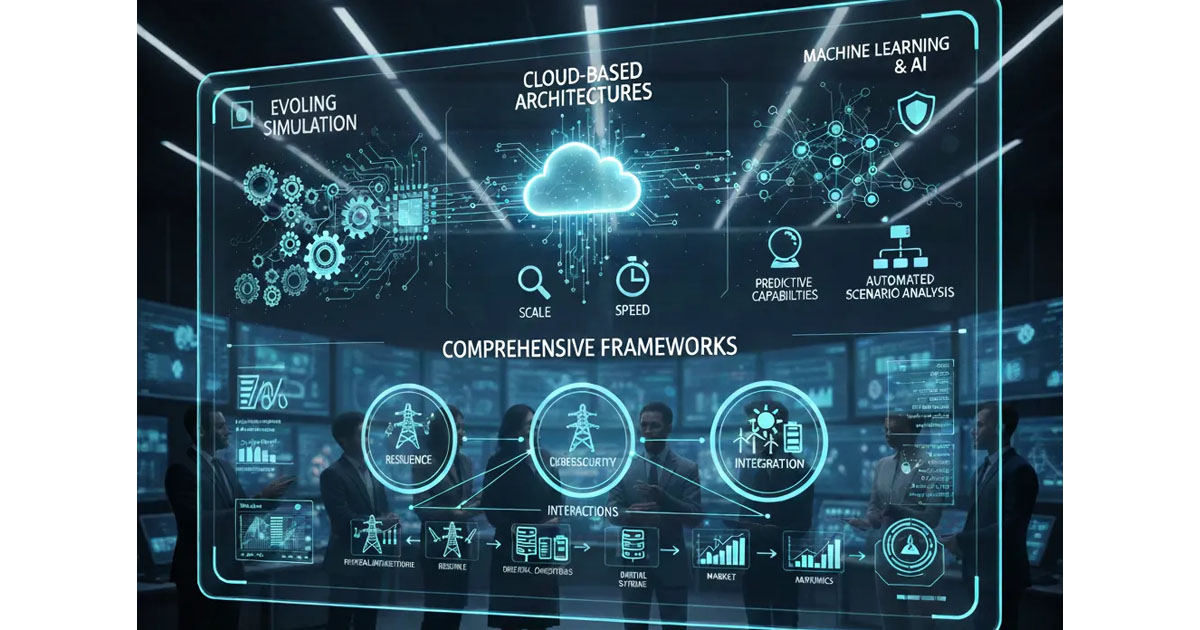
Looking ahead, the evolution of simulation technology in the electric power industry is being driven by several converging trends. The integration of high‑performance computing (HPC) and cloud‑based architectures is dramatically increasing the scale and speed of simulations, while ML and AI are being embedded to strengthen predictive capabilities and automate scenario analysis. At the same time, growing priorities around resilience, cybersecurity, and renewable energy integration highlight the need for simulation frameworks that can comprehensively capture the interactions among physical infrastructure, digital control systems, and market dynamics.
As the grid becomes more decentralized, driven by shifts in consumption patterns, the proliferation of distributed energy resources, and the adoption of new digital technologies, digital simulation will remain a critical tool for ensuring reliability, efficiency, and long‑term sustainability. Several utilities in the electric power industry have already begun successfully adopting cloud-based technologies, advancing toward more efficient and effective operations. In doing so, they are reshaping the industry’s future and accelerating the transition to cloud‑based implementations.