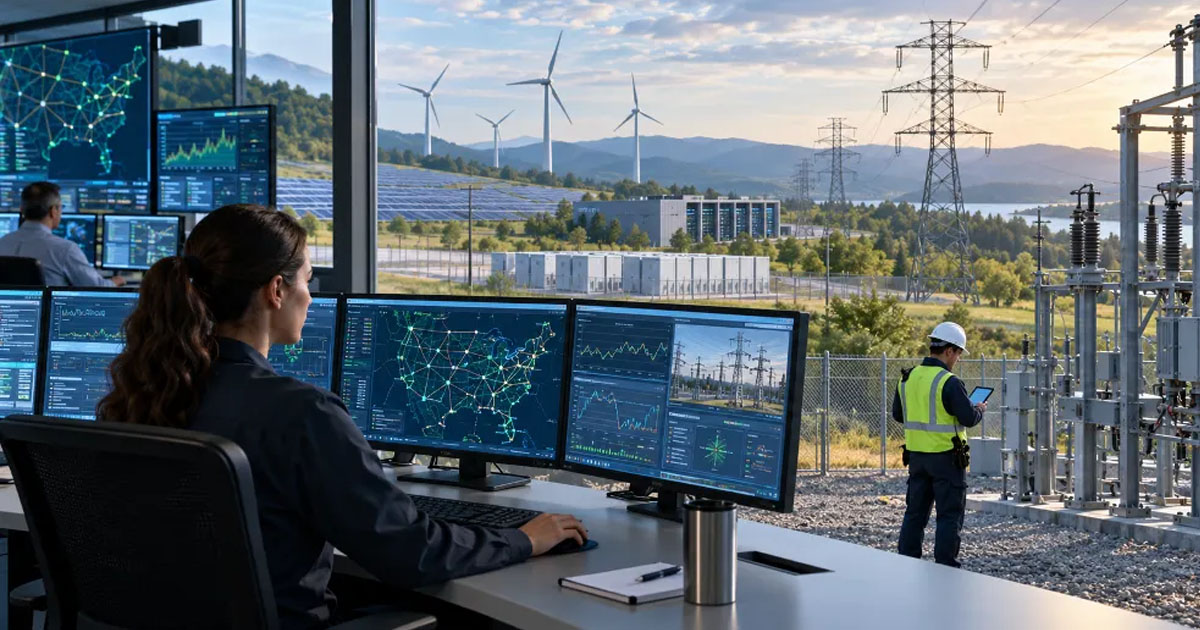
AI can help connect planning, field work, and daily operating decisions, while engineers and operators stay in the loop.
Solving Today’s Problems and Preparing for What Comes Next
A practical look at where AI already helps electric utilities, where it may go next, and what the industry needs to get right.
In a nutshell: Summary
AI is most useful in utilities when it helps people get from a problem to a sound decision faster. Today, that means better forecasting, quicker inspection review, easier outage analysis, faster interconnection screening, stronger cyber monitoring, and quicker access to company knowledge. The future may bring more continuous planning and more decision support in control rooms, but the human check still matters.
Why AI has become part of the utility conversation
Electric utilities have always dealt with uncertainty, but the pace of change is much faster now. Electric vehicles, new factories, data centers, rooftop solar, batteries, and smart buildings are all changing when and where electricity is used. The IEA expects global electricity demand to grow by 3.6% a year through 2030. For the United States, it expects growth of nearly 2% a year. Deloitte also projects U.S. peak demand could rise about 26% by 2035, with data centers making up a large share of that growth. [1] [2]
The timing is a big part of the problem. A data center can be built in one to three years, while a major grid project may take five to fifteen years. At the same time, more than 2,500 GW of generation, storage, and large-load projects are waiting in grid connection queues around the world. Utilities cannot build their way out of every constraint fast enough, so they also need better ways to use the systems they already have. [3]
AI sits on both sides of this story. The computing behind AI is helping drive new electricity demand, but AI tools can also help utilities work through more data and speed up routine work. The IEA estimates global data center electricity use was about 415 TWh in 2024 and could reach roughly 945 TWh by 2030 in its base case. [4]

Where AI is helping utilities today
Utilities are already using AI, but they are more comfortable with it in places where people have time to review the results. In an IEA survey of grid operators, only 23% reported using AI in real-time operations. The share was much higher for grid planning at 54% and for asset maintenance and operation planning at nearly 70%. [5]

Forecasting and planning
A traditional annual forecast can fall behind quickly when a large new customer appears or electric vehicle usage grows faster than expected in one part of the system. AI can help planners compare more weather patterns, load shapes, customer trends, and project scenarios. The point is not to produce one perfect forecast. It is to show planners what could happen, which cases look risky, and which assumptions deserve a closer look. [1] [2]
A simple example: An AI tool can rank hundreds of load-growth cases by the chance of overloading a transformer. Engineers can then run detailed power-flow studies only on the cases that matter most.
Inspection and maintenance
Utilities have years of photos, sensor readings, inspection notes, and work history. No field team can review all of it by hand. AI can help sort images from drones and field crews, flag possible damage or vegetation problems, and move the most urgent items to the top of the work list. The IEA cites utility examples where AI-supported inspection has cut inspection time and helped reduce tree-related outages. The final call still belongs to a technician or engineer. [4] [5]
Outage response
Storm response is also a data problem. During a major event, utilities may receive smart-meter signals, weather updates, customer calls, alarms, crew notes, and damage photos at the same time. ASCE reports that weather caused about 80% of major U.S. power outages from 2000 through 2023, and weather-related outages were twice as common in 2014 to 2023 as they were in 2000 to 2009. [6]

AI can help group related outages, point to likely fault locations, and summarize incident notes for the next shift. That can save time when the system is under pressure. Switching and re-energizing equipment, however, still need approved procedures and qualified people.
Interconnection
The same idea applies to interconnection. Solar, battery, and other projects often arrive with a lot of paperwork and repeated study work. DOE recommends better data, better hosting-capacity information, and more automation. Hosting-capacity maps can show where a feeder may have room for new projects before a developer submits a full application. AI can add another layer by checking forms for missing information, comparing a request with similar past cases, and sending straightforward cases to faster screening. [7] [8]
This does not remove the need for engineering studies. It can reduce the time engineers spend on avoidable rework and leave more time for difficult cases involving protection, voltage, thermal limits, and system upgrades. [7]
Cybersecurity
More connected devices also means more cyber risk. The IEA reports that a typical energy organization faced more than 1,500 cyberattacks per week in 2024, about three times the level four years earlier. AI can help security teams watch large streams of cyber and physical data and flag patterns that would be hard for a person to spot quickly. [9]
Sandia National Laboratories gives a useful research example. Its C2E2 project uses large language models to automate much of the data preparation needed for cyber-physical threat detection. Sandia reported that a process that had taken about two months could be reduced to a couple of hours in the research workflow, with the model reaching 95% detection accuracy. That is a research result, not a general utility benchmark, but it shows the kind of time savings utilities are exploring. [10]
Workforce support
AI can also help with a quieter problem: finding the knowledge that already exists inside the company. CEWD reports that 76% of energy and utility employers face a talent and skills gap. At the same time, experienced workers are retiring and taking years of system knowledge with them. A search assistant that works only from approved manuals, drawings, work orders, and incident records can help a newer employee find the right answer faster, especially if every answer links back to the original source. [11] [12]

What the next phase could look like
The next step is likely to be less about stand-alone AI tools and more about putting them inside normal utility work. Planning may become more continuous, with forecasts updated as new large-load requests, DER projects, weather, and customer behavior change. Field tools may give crews faster access to equipment history and approved procedures. Control rooms may get better decision support without handing final control to the model. [2] [4]
Flexible demand could also become more useful. Deloitte points to data-center pilots where 10% to 30% of load could be shifted during peak events without disrupting service. Similar ideas can apply to batteries, electric-vehicle charging, smart buildings, and other flexible loads. If utilities can see the load, trust the telemetry, and call on it when needed, some customer demand can become part of the reliability toolkit. [2]
What utilities need to get right
The hard part is not buying an AI model. It is getting the data, workflow, and responsibility clear enough that people trust the result. Utility data often lives in separate mapping, metering, outage, planning, and work-management systems. If those records disagree, the model may give a clean-looking answer built on bad inputs. DOE and the IEA both point to data quality as a basic requirement for useful automation. [4] [7]
Human review also needs to be part of the design, not something added later. A planner should be able to see why a forecast changed. A technician should be able to open the source behind a recommendation. An operator should know when the tool is uncertain and when it should defer to a person. [2]
A good place to start is a problem with a clear baseline: study hours, inspection backlog, repeat data errors, outage-analysis time, or time spent searching for procedures. If the tool saves time, improves consistency, or helps catch a problem earlier, the utility can measure that. If it does not, the project should not keep growing just because it uses AI.
A practical way to start

Where this leaves the utility industry
AI is showing up at a time when utilities have more work, more data, and less room for slow decisions. Its best near-term uses are fairly practical: forecast better, review inspections faster, sort outage information, reduce interconnection paperwork, watch for cyber threats, and make company knowledge easier to find. [1] [2] [4]
Utilities do not need AI everywhere. They need it where people are spending too much time on repetitive work (setting up the data and software configurations and similar analysis) or where a useful signal is getting lost in too much data. If the tool helps a planner, engineer, technician, or operator make a better decision and can show how it got there, it has a place.
References
· [1] IEA, Electricity 2026: Executive Summary: https://www.iea.org/reports/electricity-2026/executive-summary
· [2] Deloitte, 2026 Power and Utilities Industry Outlook: https://www.deloitte.com/us/en/insights/industry/power-and-utilities/power-and-utilities-industry-outlook.html
· [3] IEA, Electricity 2026: Grids: https://www.iea.org/reports/electricity-2026/grids
· [4] IEA, Energy and AI: Executive Summary: https://www.iea.org/reports/energy-and-ai/executive-summary
· [5] IEA, Utilities Using AI Applications by Category, 2024: https://www.iea.org/data-and-statistics/charts/utilities-using-ai-applications-by-category-2024
· [6] ASCE, 2025 Report Card for America’s Infrastructure: Energy: https://infrastructurereportcard.org/cat-item/energy-infrastructure/
· [7] U.S. DOE, i2X Distributed Energy Resource Interconnection Roadmap: https://www.energy.gov/cmei/i2x/doe-distributed-energy-resource-interconnection-roadmap
· [8] U.S. DOE, U.S. Atlas of Electric Distribution System Hosting Capacity Maps: https://www.energy.gov/eere/us-atlas-electric-distribution-system-hosting-capacity-maps
· [9] IEA, Energy and AI: AI and Energy Security: https://www.iea.org/reports/energy-and-ai/ai-and-energy-security
· [10] Sandia National Laboratories, Fighting AI with AI to Keep the Lights On: https://www.sandia.gov/labnews/2026/07/30/fighting-ai-with-ai-to-keep-the-lights-on/
· [11] CEWD, Energy Workforce Fast Facts: https://cewd.org/resources/energy-workforce-fast-facts/
· [12] Gild, The Retirement Ratio Threatening America’s Power Grid: https://www.getgild.com/posts/the-retirement-ratio-threatening-americas-power-grid
About the Author
Rakesh Belchandan is a power systems professional with experience in power generation operations, distribution planning, grid analytics, DER integration, and technology development. He believes in using advances in technology to solve practical utility problems and has worked on innovative ideas and product development aimed at making power system planning analysis faster, more efficient, and easier to scale across both distribution and transmission systems.
His interests are centered on connecting applied research with real utility needs, especially where better data, automation, analytics, and AI can improve planning and engineering decisions. He is currently serving as Secretary of the IEEE Modern and Future Distribution Systems Planning Working Group.