
Part 3: Building Production-Ready AI Agents with Amazon Bedrock AgentCore (Runtime)
Part 3: Runtime & Frontend Introduction In Part 1 and Part 2, I built the infrastructure, deployed Lambda tools via Gateway, and configured Memory for persistent context. In this final article, I complete the journey by deploying the AgentCore Runtime and building a Streamlit frontendwith secure authentication. This final article covers: Implementing the agent with […]
Part 2: Building Production-Ready AI Agents with Amazon Bedrock AgentCore (Gateway & Memory)
Part 2: AgentCore Gateway & Memory Introduction In Part 1, I established the foundation with Terraform infrastructure and Cognito authentication. In this article, I add the intelligence layer: AgentCore Gateway for serverless tools and AgentCore Memory for persistent context. This article covers: Creating Lambda-based tools accessible via MCP protocol Deploying the AgentCore Gateway Setting up […]
Part 1: Building Production-Ready AI Agents with Amazon Bedrock AgentCore (Architecture & Auth)
Part 1: Foundation, Architecture & Authentication Introduction Building a production-ready AI agent chatbot requires more than just connecting to an LLM. You need secure authentication, scalable infrastructure, persistent memory, and seamless tool integration. In this three-part series, I walk through implementing a complete Amazon Bedrock AgentCore solution for a business assistant chatbot. I’ll try to elaborate on […]
Agentic AI Fundamentals
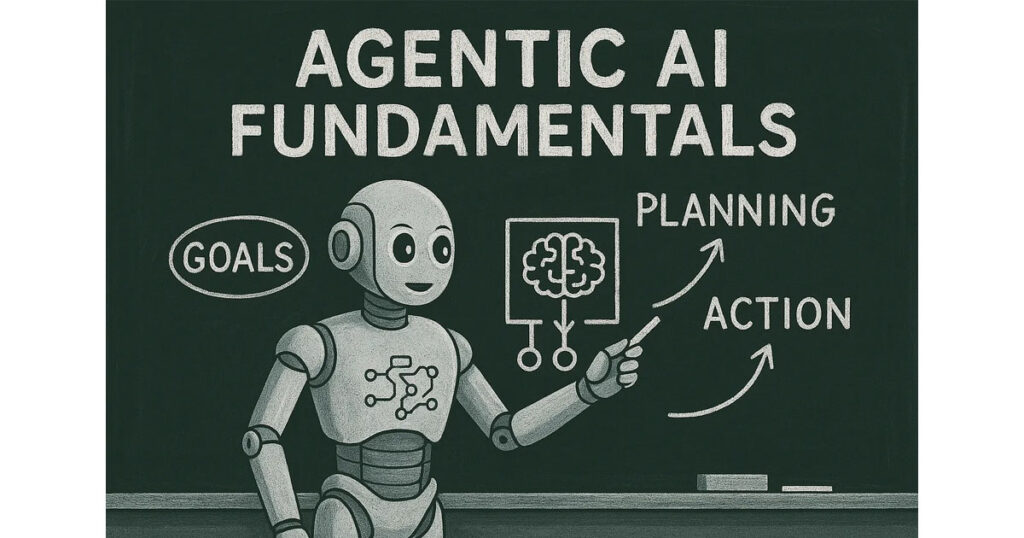
Understanding Core Concepts of Agentic AI A core challenge in Artificial Intelligence (AI) is reasoning under uncertainty. Historically, AI models were used transactionally for well-defined objectives. However, with the emergent knowledge and reasoning capabilities of Large Language Models (LLMs) attained over the last decade, even more complex and open-ended problems can now be solved autonomously. […]
Culture is the Code

Organizational change, rather than technical performance, will drive successful adoption of Agentic AI. Enterprise software has always carried an implicit theory of organization. Mainframes embodied centralization. ERPs encoded bureaucratic workflows. Rule engines and decision trees promised certainty by reducing ambiguity to fixed logic. These systems were designed for a world that valued compliance, stability, and efficiency over adaptability. […]